Education Is Changing. The Role of Educators Is Evolving.
Education has always been about preparing people for the future.
For generations, teachers have played an essential role in helping students develop knowledge, confidence, critical thinking, and the ability to contribute to society.
Today, however, the world in which students learn is changing rapidly.
Artificial intelligence, online learning platforms, digital classrooms, and new communication technologies are transforming how knowledge is accessed, shared, and applied.
Students can now explore educational resources from almost anywhere, participate in virtual learning environments, and use digital tools to support their studies.
These developments create new opportunities for education, but they also introduce new responsibilities for teachers and educational leaders.
Being an effective educator today requires more than subject knowledge. It requires the ability to adapt, innovate, and guide learners through an increasingly digital world.
The future of education will depend not only on technology itself, but also on the professionals who understand how to use it responsibly and effectively.
The Digital Transformation of Education
The traditional classroom is no longer the only environment in which meaningful learning takes place.
Digital technology has expanded educational opportunities beyond physical classrooms and fixed schedules.
Students can access recorded lectures, participate in online discussions, complete interactive assignments, and collaborate with others across geographical boundaries.
For educational institutions, these developments create opportunities to reach learners with different backgrounds, responsibilities, and learning needs.
However, introducing technology into education does not automatically improve learning outcomes.
The effectiveness of digital education depends on how tools are selected, how lessons are designed, and how students are supported.
The OECD Digital Education Outlook 2026 emphasizes that generative AI has the potential to improve teaching and learning, but its benefits depend on appropriate educational design and careful management of risks.
This highlights an important principle:
Technology should support effective teaching, not replace the educational judgment that makes learning meaningful.
Why Traditional Teaching Skills Are No Longer Enough
Strong communication, subject expertise, classroom management, and instructional planning remain fundamental to effective education.
These skills have not become less important.
Instead, educators now need additional capabilities to apply them successfully in modern learning environments.
A teacher who understands a subject thoroughly may still face challenges when delivering lessons online, evaluating AI-assisted assignments, or supporting students with different levels of digital access.
Similarly, an educational administrator may need to understand digital learning systems, student information platforms, and data-informed decision-making.
The challenge is not simply learning to operate new software.
It is understanding how digital tools influence student engagement, learning behavior, assessment, accessibility, and educational quality.
Modern educators must combine established teaching principles with emerging technological competencies.
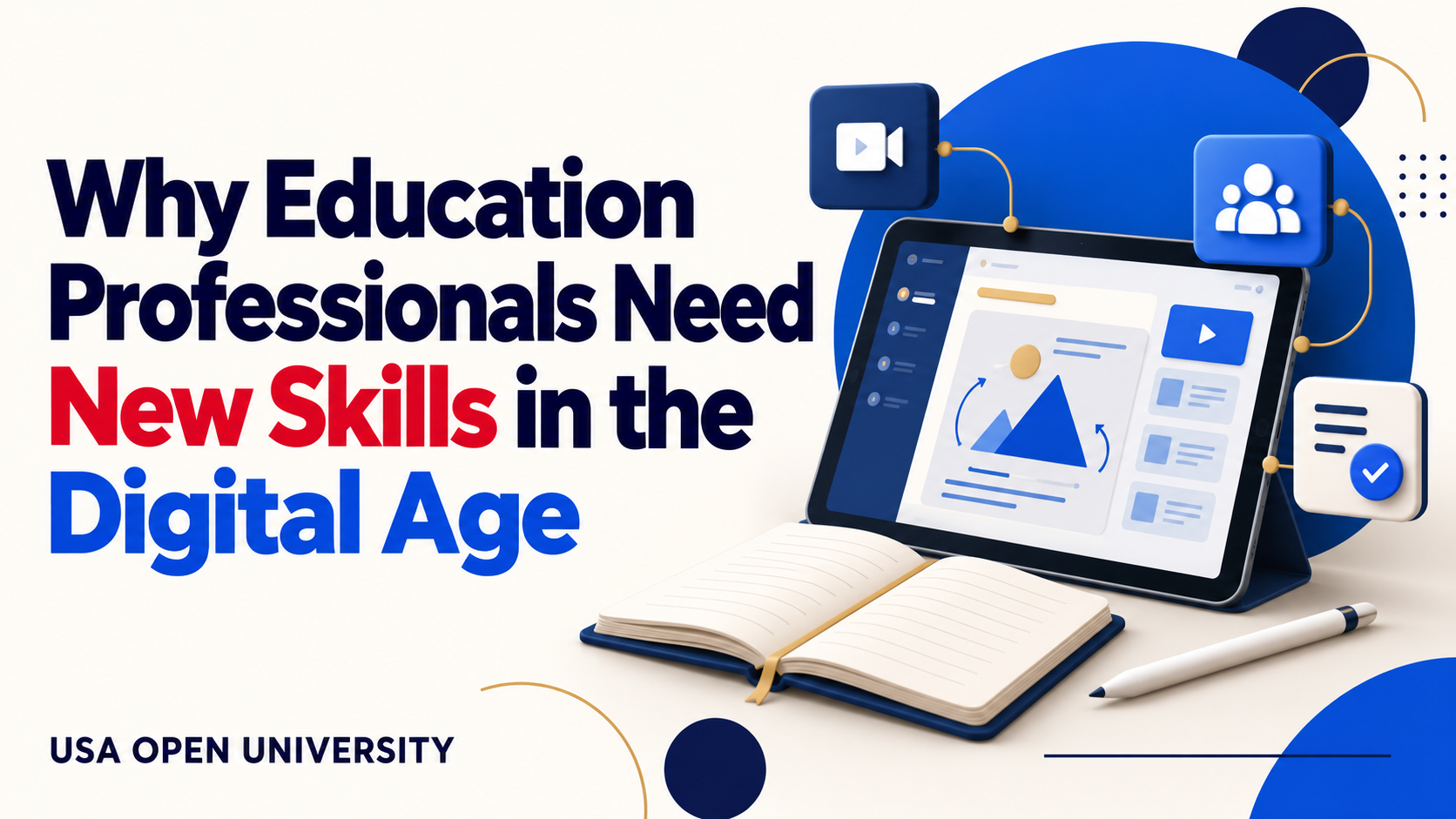
Seven Essential Skills for Education Professionals in the Digital Age
As education continues to evolve, several skills are becoming increasingly important for teachers, educational administrators, instructional designers, and other education professionals.
1. Digital Literacy
Digital literacy is the ability to use, evaluate, and communicate information through digital technologies.
For educators, this includes understanding how to navigate online learning platforms, create digital learning materials, manage electronic resources, and communicate effectively in virtual environments.
Digital literacy also involves recognizing unreliable information and helping students evaluate online sources critically.
An educator with strong digital literacy can make more informed decisions about which technologies genuinely support learning.
The goal is not to use every new digital tool.
It is to select appropriate tools that serve clear educational objectives.
2. Artificial Intelligence Literacy
Artificial intelligence is becoming an increasingly visible part of education.
AI-powered tools can assist with lesson preparation, educational content development, language support, and certain administrative activities.
However, educators must understand both the capabilities and limitations of these systems.
AI-generated information can be inaccurate, incomplete, or misleading. AI systems can also raise concerns about privacy, bias, academic integrity, and student independence.
UNESCO's AI Competency Framework for Teachers identifies five important areas of professional competence:
- A human-centered approach to technology
- Ethics and responsible AI use
- AI foundations and applications
- AI-supported teaching methods
- AI for continuous professional development
These areas demonstrate that AI literacy involves much more than knowing how to enter instructions into a digital tool.
It requires critical thinking, ethical awareness, and professional judgment.
Educators do not need to become AI engineers. They need to understand how AI affects teaching and learning.
3. Online Teaching and Instructional Design
Teaching online requires more than transferring traditional classroom materials onto a digital platform.
Effective online education depends on thoughtful instructional design.
Educators must consider how students will interact with learning materials, receive feedback, demonstrate understanding, and remain engaged throughout a course.
This may involve developing structured learning modules, combining different types of educational resources, and creating opportunities for meaningful interaction.
For example, a recorded lecture may communicate important information, but discussion activities, practical exercises, and reflective assignments can help students apply what they have learned.
Effective instructional design ensures that technology supports learning objectives rather than distracting from them.
4. Data Literacy and Educational Assessment
Digital learning environments can generate information about student participation, assignment completion, assessment results, and learning progress.
When interpreted responsibly, this information can help educators identify areas where students may need additional support.
Data literacy involves understanding what educational data can reveal, recognizing its limitations, and using it to inform decisions.
For example, low participation in an online course may indicate several different challenges, including limited internet access, unclear instructions, competing responsibilities, or difficulty understanding the material.
The data alone does not explain the cause.
Educators must combine quantitative information with communication, observation, and professional judgment.
Responsible data use also requires attention to student privacy and appropriate information security practices.
5. Critical Thinking and Digital Ethics
In an environment where information can be generated and distributed instantly, critical thinking is becoming increasingly important.
Students need guidance in distinguishing credible evidence from misinformation, evaluating AI-generated responses, and understanding the ethical implications of digital technologies.
Educators have a responsibility to model these practices.
This includes discussing academic honesty, intellectual property, data privacy, algorithmic bias, and responsible online behavior.
For example, students may use AI tools to brainstorm ideas or clarify difficult concepts.
However, they also need to understand the difference between using technology to support their learning and relying on it to complete work without developing genuine understanding.
The objective is to develop independent thinkers who can use technology thoughtfully.
6. Communication, Collaboration, and Emotional Intelligence
Technology can improve communication, but it cannot eliminate the need for meaningful human relationships.
Students still need encouragement, constructive feedback, clear expectations, and a sense of belonging.
In online and blended learning environments, educators may need to communicate through discussion forums, video meetings, written feedback, and collaborative digital platforms.
These interactions require clarity, empathy, and cultural awareness.
Emotional intelligence helps educators recognize student difficulties, respond constructively to challenges, and create supportive learning environments.
As classrooms become increasingly connected across locations and cultures, the ability to communicate effectively with diverse learners remains essential.
7. Adaptability and Lifelong Learning
Perhaps the most important skill for modern education professionals is the willingness to continue learning.
Digital technologies change, educational research develops, and student expectations evolve.
A teaching method that works effectively in one environment may require adjustment in another.
Educators who embrace professional development are better positioned to evaluate new approaches and respond to changing educational needs.
Lifelong learning may involve academic study, professional workshops, research, collaboration with colleagues, and practical experimentation with educational methods.
The strongest educators are not those who believe they have finished learning. They are those who continue developing alongside their students.
Artificial Intelligence Will Change Teaching, but Human Educators Remain Essential
One of the most important questions facing education today is whether artificial intelligence will replace teachers.
AI can perform certain tasks quickly, including generating practice questions, organizing information, and suggesting instructional resources.
However, education involves responsibilities that extend beyond producing information.
Teachers interpret student needs, establish expectations, encourage curiosity, recognize emotional challenges, and make complex decisions about learning.
These responsibilities require contextual understanding, accountability, and human relationships.
The OECD's 2026 research also highlights an important risk: students may perform better on AI-assisted tasks without necessarily developing stronger independent understanding.
This distinction matters.
Completing an assignment is not always the same as learning the concepts behind it.
Educators must therefore design learning experiences that encourage reasoning, reflection, creativity, and independent problem-solving.
The most valuable role of AI in education is to support educators in achieving meaningful learning outcomes while preserving their professional autonomy.
The Importance of Inclusive Digital Education
Digital transformation also raises important questions about educational access.
Not every student has the same internet connectivity, devices, technological experience, or learning environment.
Some learners may face accessibility challenges, language barriers, or limited opportunities to participate in synchronous online activities.
Education professionals must consider these differences when designing and delivering instruction.
Inclusive digital education may involve providing accessible learning materials, offering alternative participation methods, using clear language, and selecting tools that work across different devices.
For example, an asynchronous learning activity may provide greater flexibility for a working student who cannot attend a scheduled live session.
Similarly, captions, transcripts, and accessible document formats can improve the learning experience for students with different needs.
Technology can expand educational access, but only when inclusion is part of the design process.
Why Educational Leadership Must Evolve
Digital transformation affects more than individual classrooms.
School administrators, academic coordinators, curriculum developers, and educational leaders also face new responsibilities.
Institutions must make decisions about technology investments, professional development, student support, data protection, and educational quality.
Effective educational leadership requires understanding both the opportunities and limitations of digital systems.
Leaders need to ask important questions:
- Does this technology address a genuine educational need?
- Are educators adequately prepared to use it?
- How will its impact on student learning be evaluated?
- Are privacy, accessibility, and ethical requirements being considered?
- Can the institution sustain its implementation over time?
These questions demonstrate why educational leadership increasingly requires strategic planning, technological awareness, and evidence-based decision-making.
Successful digital transformation is not measured by the number of tools an institution adopts.
It is measured by how effectively those tools support students, educators, and institutional objectives.
How Education Professionals Can Develop Future-Ready Skills
Developing digital competencies does not require mastering every emerging technology immediately.
A more effective approach is to build skills progressively.
Start With Core Digital Competencies
Educators can begin by strengthening their understanding of learning management systems, online communication, digital content creation, and information evaluation.
These foundational skills support more advanced technological learning.
Explore AI With Clear Educational Objectives
Rather than adopting AI simply because it is available, educators should identify specific teaching challenges that appropriate tools might help address.
They should evaluate outputs carefully and follow applicable institutional policies.
Strengthen Instructional Design Skills
Understanding how people learn is essential to designing effective digital experiences.
Educators can benefit from studying assessment methods, learning objectives, student engagement, and accessible course design.
Learn From Research and Professional Communities
Educational research and collaboration can help professionals evaluate new teaching approaches.
Sharing experiences with colleagues also creates opportunities to identify practical solutions and avoid common implementation challenges.
Invest in Continuous Professional Development
Formal education, short courses, professional training, and independent study can all contribute to long-term growth.
The key is maintaining a commitment to learning and applying new knowledge responsibly.
Preparing for the Future of Education at USA Open University
As educational environments evolve, academic preparation remains an important foundation for those pursuing careers in teaching, educational administration, curriculum development, and related fields.
USA Open University recognizes the importance of accessible and flexible higher education for modern learners.
Its academic catalog includes a Bachelor of Education program designed to provide undergraduate study in the field of education.
The published program overview lists:
| Program InformationDetails | |
| Degree | Bachelor of Education |
| Duration | 4 Years |
| Total Courses | 38 |
| Academic Credits | 112 |
| Study Format | Online |
| Learning Delivery | Asynchronous |
The university's online learning model can provide flexibility for students balancing academic goals with employment, family responsibilities, and other commitments.
For aspiring education professionals, university study can help establish a foundation for understanding educational principles, instructional practice, and professional responsibilities.
For experienced educators, continued academic and professional development can support deeper reflection on teaching methods and changing educational needs.
Students interested in a specific teaching career should also review the licensing and professional qualification requirements applicable in the country or region where they intend to work.
An academic degree and authorization to teach are not necessarily the same qualification.
Education That Responds to a Changing World
The future of education requires professionals who understand both people and technology.
Academic learning can contribute to the development of critical thinking, communication, research, and professional knowledge.
These capabilities remain valuable as educational institutions adapt to new technologies and changing student expectations.
At USA Open University, the broader goal of flexible higher education aligns with an important principle of modern professional development:
Education should support continued growth throughout a person's academic and professional journey.
The Future of Education Depends on People Who Keep Learning
Technology will continue to influence how education is delivered and experienced.
Artificial intelligence, digital learning environments, and new instructional methods will create opportunities to rethink traditional approaches.
However, technological progress alone does not guarantee educational progress.
Meaningful improvement requires educators who understand learning, evaluate evidence, act ethically, and place student development at the center of their decisions.
Future-ready education professionals will need to combine established teaching knowledge with digital literacy, adaptability, creativity, and responsible technology use.
They will also need to recognize that professional growth is a continuous process.
The ability to learn new skills is no longer simply an advantage.
It is an essential part of remaining effective in a changing educational environment.
Conclusion: The Future of Education Begins With Educators
The digital age is transforming education, but its most important resource remains the people responsible for guiding learning.
Teachers, academic leaders, and education professionals shape how technology is introduced, how students develop understanding, and how learning experiences are designed.
Their responsibilities are expanding, and the skills needed to fulfill them are evolving.
Digital literacy, AI awareness, instructional design, critical thinking, communication, and lifelong learning are increasingly important parts of professional preparation.
Technology may change how we teach. But skilled educators determine how effectively students learn.
The future of education will not be shaped by technology alone.
It will be shaped by education professionals who are prepared to use it wisely.
Build Your Future in Education With USA Open University
Are you interested in developing your knowledge of education and preparing for a field that continues to evolve?
Explore academic opportunities at USA Open University and discover how flexible higher education can support your learning goals.
Whether you are beginning your academic journey or considering your next stage of professional development, investing in education is an investment in your ability to contribute to the future.
Keep Learning. Keep Growing. Help Shape the Future of Education.
Explore Education Programs: https://usaou.us/programs
USA Open University | Education Beyond Borders
References
- UNESCO. (2024). AI Competency Framework for Teachers. https://www.unesco.org/en/articles/ai-competency-framework-teachers
- OECD. (2026). OECD Digital Education Outlook 2026: Exploring Effective Uses of Generative AI in Education. https://www.oecd.org/en/publications/oecd-digital-education-outlook-2026_062a7394-en.html
- USA Open University. (2026). Academic Programs Catalog. https://usaou.us/programs?level=bachelor